
2022-23 Laureates
Every year, The Tech for Global Good program celebrates innovators using technology to tackle big problems. In 2022-23, The Tech for Global Good honors four laureates who are creating a more sustainable future. To continue our work in advancing data science education, we have chosen two laureates who use data to advance their work.
Blue Ocean Barns
Kailua-Kona, HIPresented by Patrick J. McGovern Foundation
What they do: Blue Ocean Barns is solving agriculture’s biggest sustainability challenge by working with dairy and beef producers to remove greenhouse gas emissions directly from their supply chains. By the end of this decade, they will be growing enough red seaweed to supplement all 100 million cattle in the US, reducing methane emissions from cattle farming by 80%.
- The Problem In a single year, one car produces the same amount of climate-warming gas as one cow. Blue Ocean Barns is using seaweed to dramatically reduce the greenhouse gases emitted by cows all over the world. Discover the Problem
- The Innovator Joan's family had been farming in the United States since the Revolutionary War. Once Joan learned how much methane cows released into the atmosphere, she went back to school to learn more and found a promising study on red seaweed in cows' diets. She put together a research team and verified that feeding cows red seaweed decreased the amount of methane they produced significantly. Meet the Innovator
- The Solution Blue Ocean Barns reduces the amount of methane that cows release into the atmosphere by adding red seaweed to what they eat. Uncover the Solution
- The Impact In the next 10 years, Blue Ocean Barns expects to feed red seaweed to all 100 million cows in the United States, reducing the total amount of methane cows release into the atmosphere and having an immediate cooling effect on the planet. Understand the Impact
- Watch with Spanish subtitles View Playlist
Goodr
Atlanta, GAPresented by NetApp
What they do: Goodr is on a mission to end food waste, fight hunger and feed communities using the power of technology and logistics. They have served food to 30 million people in need while diverting nearly 4 million pounds of food away from landfills.
* Data Science Laureate
- The Problem Across the United States today, nearly 50 million people are food insecure. At the same time, the United States wastes a lot of food; we are throwing away 40% of the food we produce. Discover the Problem
- The Innovator After seeing so many people who were in need, Jasmine started doing pop-up meals. She soon learned about the problem of food waste and had an idea to use the technology of food delivery apps to get food from restaurants and grocery stores that would otherwise be thrown out into the hands of people in need. Meet the Innovator
- The Solution Goodr's app works like food delivery apps, but in reverse. When a grocery store or restaurant has excess food items, they use the app to select the food they are donating, and then a driver is notified through the app and arrives to pick up the food items. The algorithm matches the donated food to a non-profit, and food is delivered directly to them. Uncover the Solution
- The Impact Goodr is operating all over the United States, helping anyone who is in the food business reduce their food waste by delivering their excess fresh food to organizations feeding people in need. Understand the Impact
- Watch with Spanish subtitles View Playlist
MicroByre
Berkeley, CAPresented by Barbara and John Glynn
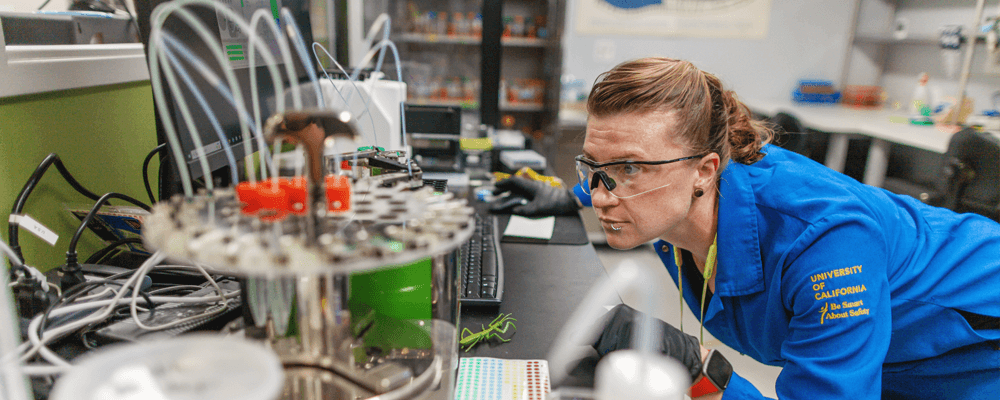
What they do: MicroByre wants to turn bacteria into climate-friendly factories. To achieve this, they rely on robotics and automation to rapidly measure and catalog bacteria. This data is used to determine which bacteria can help transform bio-waste into life-saving cancer drugs, jet fuel, fertilizer, and other chemicals. Their production methods will one day break our reliance on petroleum and radically reduce our carbon emissions.
* Data Science Laureate
- The Problem Today, we heavily rely on oil to make many of the same chemicals we used to make from plants and microbes; we call them petrochemicals. But using petroleum, instead of fresh biomass, pollutes our air, water, and soil, and disrupts our ecosystems. Discover the Problem
- The Innovator As a high school student, Sarah was accepted into a science program at Johns Hopkins University School of Medicine, where she saw scientific research for the first time and realized she wanted to become a microbiologist. Meet the Innovator
- The Solution MicroByre is domesticating novel bacteria to optimize their natural ability. They are building a giant database through the use of robotics and technology that help them monitor and record how bacteria respond to different conditions. Uncover the Solution
- The Impact MicroByre has been building their bacterial library and functional dataset since 2017. This data is used to determine which bacteria can help transform bio-waste into life-saving cancer drugs, jet fuel, fertilizer, and other chemicals. Their production methods will one day break our reliance on petroleum and radically reduce our carbon emissions. Understand the Impact
- Watch with Spanish subtitles View Playlist
Strawcture Eco
Delhi, IndiaPresented by The Swanson Foundation
What they do: Strawcture Eco provides 100% biobased composite building panels made from agri-residue (straw that would otherwise be burnt or disposed of) to reduce the carbon footprint of the built environment.
- The Problem All across our world today, the sourcing of building and construction material is having a devastating impact on our climate, stretching our planet's natural resources to the limit. Discover the Problem
- The Innovator Shriti grew up in New Delhi and was around construction all the time. She wanted to be a part of the growth, so she went to NYU to study construction. During her fellowship program in rural India, she began researching the potential of using straw as a building material. Meet the Innovator
- The Solution Farmers sell their straw to Strawcture Eco, who preps and mixes it up with an adhesive. Then it goes through a machine to be turned into a panel. The panels can be used for walls, ceilings, doors and furniture. They have a high fire resistance rating of over 2 hours and are moisture-resistant and termite-proof. Uncover the Solution
- The Impact Strawcture Eco provides 100% biobased composite building panels made from agri-residue (straw that would otherwise be burnt or disposed of) to reduce the carbon footprint of the built environment. Strawcture panels are being used as a building material all across India and they are beginning to ship to the Middle East and other parts of Asia. Understand the Impact
- Watch with Spanish subtitles View Playlist
Previous Years' Laureates
This Year's Laureates The Tech for Global Good
Aluna
Arcade Therapeutics
Biobot Analytics
Cionic
Blue Ocean Barns
Goodr
MicroByre
Strawcture Eco
Blue Sky Analytics
Buzz Solutions
Ushahidi
Wild Me
Chipsafer
Destination: Home
Opportunity Insights
UNICEF's Magicbox